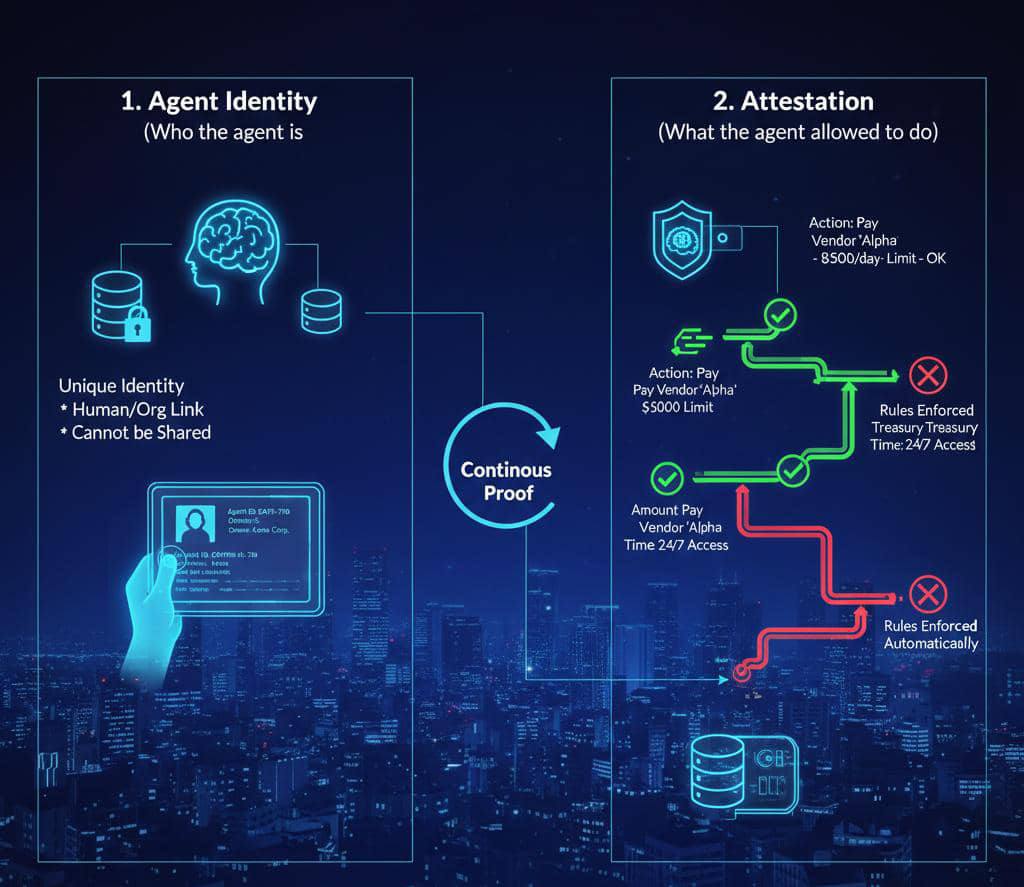
Agent Identity & Attestation
How software agents prove who they are and what they’re allowed to do.
For AI agents to safely use money, the system must answer two basic questions:
- Who is this agent?
- What is this agent allowed to do?
Agent identity and attestation are how Catena answers those questions before any money moves.
What agent identity means
Agent identity is a unique, verifiable identity for each software agent. It is like a digital ID card for an AI agent.
Why this matters
Without identity:
- Agents can pretend to be others
- Actions cannot be traced
- Responsibility is unclear
- Trust breaks
For finance, this is unacceptable.
How Catena creates agent identity
With Catena:
- Each agent is registered once
- It gets a unique identity
- It is linked to a human or organization
- It cannot be copied or shared
So when an agent acts, the system knows exactly which agent it is.
What attestation means
Attestation is proof of an agent’s permissions.
It answers:
- What tasks the agent can perform
- How much money it can spend
- Who it can pay
- When it can act
Think of it as a permission badge attached to the agent.
Why this matters
An agent may be real, but still dangerous if:
- It has unlimited access
- It can break rules
- It can act without limits
Attestation prevents this.
How Catena handles attestation
In Catena:
- Humans define the rules first
- These rules are attached to the agent’s identity
- Every action is checked against these rules
If an action is not allowed:
- It is blocked automatically
- No human intervention is needed
Why one time checks are not enough
Agents change:
- They update
- They gain new tasks
- Their permissions may need adjusting
A one time approval is risky.
How Catena solves this
Catena:
- Continuously checks agent identity
- Continuously verifies permissions
- Re validates before every transaction
So the system always knows:
- The agent is real
- The agent is still allowed to act
The key idea
Catena does not “trust” agents blindly. Instead:
- Identity proves who the agent is
- Attestation proves what it can do
- Rules enforce safe behavior
With this, trust becomes designed, not assumed.
- A company creates an AI agent
- The agent is registered and gets an identity
- The company sets spending and action rules
- The agent requests a payment
- Catena checks identity and permissions
- Payment is allowed or blocked
Everything is clear and controlled.
Agent identity tells Catena who an agent is, and attestation proves what that agent is allowed to do making safe, accountable agent finance possible.